
CI/CD pipelines
Automated build, test and deploy so releases are a single click.
Maintenance & DevOps
Monitoring, backups and a CI/CD pipeline that makes shipping predictable, plus a real person to call when something breaks.
Why it matters
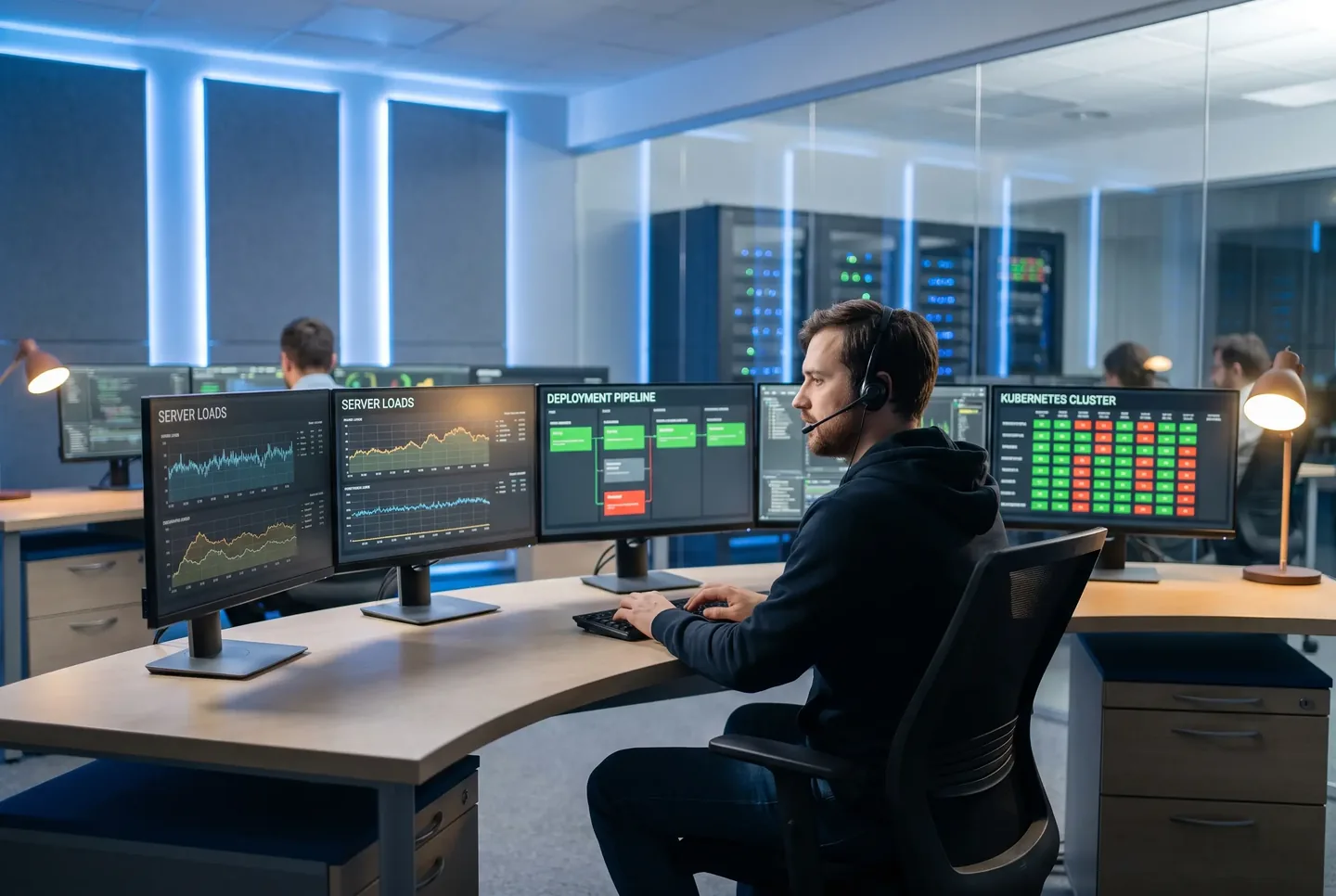
Whether we built your product or inherited it, we'll get it onto a pipeline where releases are one click and rollbacks are painless. Then we keep an eye on it, patching, backing up and responding when alerts fire, so your team can stay focused on the product itself.


What's included
Automated build, test and deploy so releases are a single click.
Uptime, performance and error tracking with alerting that reaches a human.
Tested backups and a recovery plan you can actually rely on.
Dependencies and servers kept current and sensibly hardened.
Right-sized AWS or Cloudflare infrastructure that won't overspend.
Agreed response times and a person who already knows your system.
Process
We map your goals, users and constraints, then agree a scope and a fixed estimate.
Wireframes, prototypes and a design system, validated with real users.
Two-week sprints with a working demo at the end of every one.
Automated and manual testing across devices before anything reaches users.
A rehearsed release with monitoring in place, not a fingers-crossed deploy.
Ongoing iteration, maintenance and a real person to call when you need one.
Why Infyze
The people who scope your project are the ones who build it, no junior bait-and-switch.
Work is broken into two-week increments you can see and steer, priced before we build.
You never wait months to see progress. Each week ends with something you can click.
The repository, the pipeline and the documentation are yours. No lock-in, no dependency.
We tie the work to numbers that matter to you and report against them honestly.
Support and iteration are part of the relationship, not an upsell once real users arrive.
The stack
We pick tools to fit your product and team, not by fashion, and we document why, so the choice still makes sense a year from now.
FAQ
Support is usually structured as a predictable monthly retainer, sized to your stack's complexity and the response times you actually need, agreed in writing up front so there are no surprise invoices when something breaks at an inconvenient time. A simple application with modest traffic and a small stack costs meaningfully less to support than a complex platform with multiple services and strict uptime requirements, and we scope the retainer to match your real risk rather than a one-size-fits-all package. If you are also weighing a new build or a rebuild of an existing system, try our free cost calculator for a rough ballpark on that separate piece of work. As a general shape, a basic retainer covering monitoring, patching and standard business-hours response typically starts in the low hundreds per month; faster response times or more complex infrastructure increase that.
Yes, and this is a substantial part of our maintenance work, not an edge case we reluctantly accept. Whether we built your product originally or inherited it from a previous team, freelancer or agency, we start with a short technical audit covering the codebase, hosting setup, backup status and any existing monitoring, so we understand what we are taking on before committing to anything. From there we get it onto a reliable deployment pipeline with proper monitoring and tested backups, since it is common for inherited systems to have neither in any real working state despite appearing fine day to day, and then keep it patched and healthy going forward. We are honest during that initial audit if we find something concerning, an outdated framework with known security issues, or backups that have silently been failing for months, rather than quietly taking on the risk without telling you.
Agreed response times that scale with severity, a critical outage gets a faster commitment than a minor cosmetic bug, monitoring and alerting configured to actually reach a real person rather than sitting unread in an inbox, and tested backups we have verified can actually be restored, not backups that silently exist without anyone confirming they work. It also includes security patching for dependencies and the underlying server as vulnerabilities are disclosed, rather than waiting for an annual review while known issues sit exposed, and a one-click deploy and rollback pipeline so releases stay boring and predictable instead of a stressful, manual process each time. Beyond the technical baseline, you get a specific person who already knows your codebase to contact when something comes up, rather than starting from zero with a generic support queue every time.
To an agreed service-level agreement set during onboarding, typically measured in hours for anything affecting live users and faster for anything critical, with a specific person who already knows your system responding rather than a generic help desk starting from a blank slate. We set these response times up front in writing so you know exactly what to expect before anything goes wrong, rather than discovering the real response time for the first time during an actual incident. Because the same team maintains your system on an ongoing basis, diagnosis is typically much faster than with a cold support queue, since we already understand the architecture and likely failure points. After a serious incident, we also do a short retrospective covering what happened and what changes reduce the chance of it recurring, rather than just patching the symptom.
Often, yes, and it is one of the more satisfying parts of maintenance work because the savings are usually concrete and immediate. We right-size AWS or Cloudflare infrastructure so you are not paying for capacity, unused reserved instances, oversized database tiers, redundant storage, that you do not actually need, which is extremely common on systems provisioned once early on and never revisited as real usage patterns became clear. We also make the running costs visible with proper cost monitoring and tagging, since a lot of teams simply do not know which part of their infrastructure is actually expensive until someone breaks the bill down by service, at which point the biggest line item is often surprising. Typical savings from a first pass often land in the twenty to forty percent range, though this depends entirely on how the system was originally provisioned.
Send a few details and we'll reply within one business day with honest first thoughts: a call, a rough estimate, or a pointer in a better direction.